
Quick Summary
- Choose one viewer question and one result the video can actually deliver before writing the hook.
- Write the opening around the specific problem and show the answer early; do not promise a result the footage cannot support.
- Outline the evidence or demonstration before polishing the spoken Tamil or Tanglish lines.
- Use the copyable template below, then compare it with a completed one-minute phone-audio example.
- Read the draft aloud, time it and revise the unnatural parts. No fixed word count or language ratio works for every creator.
You have a video idea but a blank document in front of you. Start with what the viewer needs to understand or do by the end, and what you can show on camera. The script then becomes a sequence of useful moments rather than a polished introduction with no answer behind it.
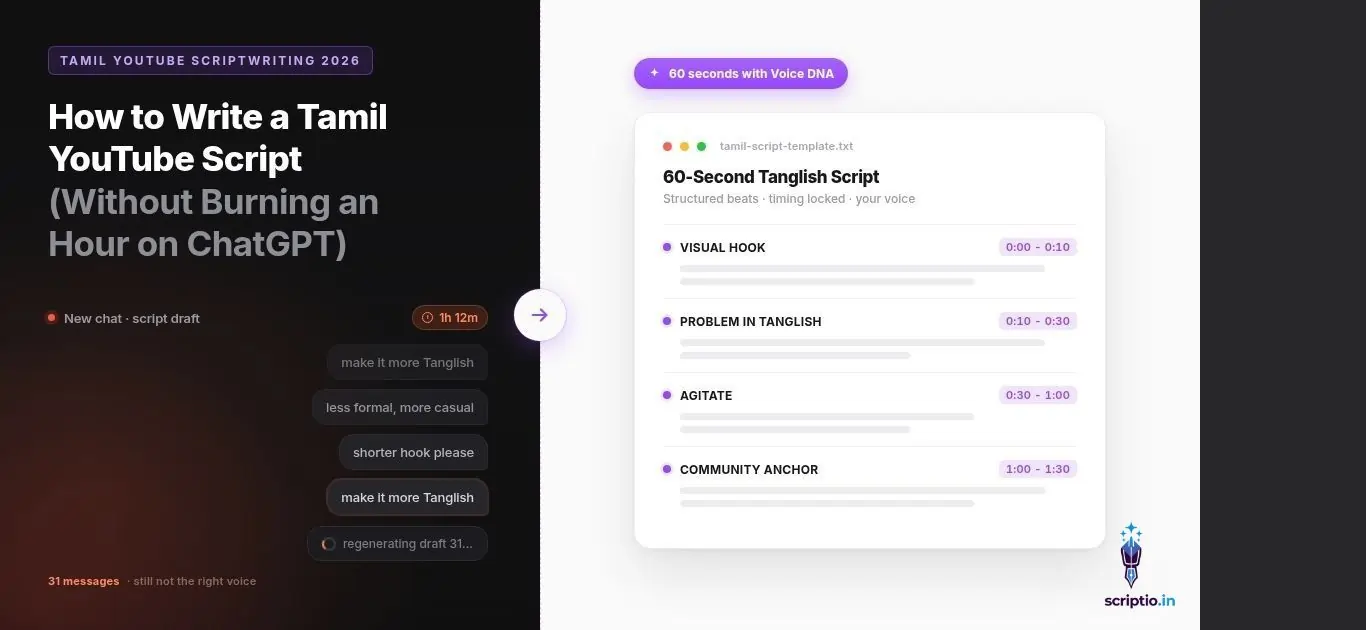
Seven steps to a recordable script
- Name the viewer and task. Write “This is for…” and the question they brought. One video can address more than one detail, but the central promise should stay clear.
- List what you know and can show. Separate tested facts, sourced claims, personal opinions and unanswered questions. Do not let a script generator fill gaps with invented numbers.
- Choose the format and scope. A 60-second Short needs one answer; a longer tutorial can include context, demonstration, exceptions and recap.
- Draft an honest hook. Name the problem and the specific payoff. The first line does not need to hide the subject to create curiosity.
- Order the proof. Put the demonstration or core explanation where a viewer expects it, then add the detail required to understand it.
- Write in your spoken language. Choose Tamil, Tanglish or English terms that your viewers recognize. Keep technical names accurate and read the lines aloud; literal translation may sound stiff.
- Edit against the footage. Check every claim, rehearse the timing, remove repetitions and ensure the title and thumbnail promise what the video actually delivers.
There is no universal “30-second hook math” or retention percentage. Your pace depends on the topic, format and how naturally you speak. Use YouTube Analytics after publishing to learn where your viewers leave or replay, then revise future scripts accordingly.
Copyable Tamil or Tanglish script template
Paste this into a note or document and replace the bracketed prompts. It is a planning template, not a script that should be read with the brackets intact.
Viewer: [Who needs this?]
Question: [What do they want to know or do?]
Evidence: [What can I show, test or cite?]
Limit: [What have I not tested or established?]

HOOK: [Name the problem and the payoff this video can deliver.]
CONTEXT: [Explain only what viewers need before the demonstration.]
STEP 1: [Show or explain the first action.]
STEP 2: [Show or explain the second action.]
CHECK: [How can viewers tell whether it worked?]
LIMITATION: [When might the result differ?]
ENDING: [Recap the useful answer and one relevant next action.]
Completed example: a short phone-audio tutorial
This illustrative example assumes the creator recorded their own quiet-room and noisy-room clips. It does not claim that every phone or microphone will produce the same result.
| Template field | Completed note |
|---|---|
| Viewer | First-time Tamil creators recording on a phone |
| Question | Why does the voice recording sound noisy? |
| Evidence | Creator's two sample clips, recorded at the same speaking distance |
| Limit | No measured decibel reduction; different rooms and devices vary |
“Phone-la record pannumbodhu background noise romba kekkudha? Naan same phone-la rendu short clips record pannirukken. First clip-la fan on; second clip-la fan off, phone-um mouth-kku konjam closer. Rendu audio-vum ippo kelunga. Ungal room-la test pannumbodhu volume same-a vechitu compare pannunga. Indha setup ellarukkum same result kudukkum-nu solla mudiyadhu, aana unga recording-ku enna difference varudhu-nu neengale check pannalam.”
The opening names the problem, the body points to the actual clips and the ending gives a test the viewer can repeat. Before recording, a fluent speaker should adjust the Tanglish to the creator's own dialect and ensure the clip descriptions match the footage.
Use AI as a draft assistant
A writing tool can organize the brief or offer alternative hooks. Give it the viewer, footage, facts and exclusions, then verify every line. Scriptio is on a break until April 1, 2027; choose based on how much editing the result needs for your video. Scriptio's optional Voice DNA can guide phrasing from suitable channel speech, but it is not an exact voice-match guarantee.
Should I write a Tamil YouTube script in Tamil or Tanglish?
Use the language your intended audience understands and wording you can speak naturally. Both can work; check your topic and channel rather than applying a universal ratio.
Can ChatGPT or Claude write a Tamil YouTube script?
Yes. Give either tool a clear brief and voice examples, then verify facts and spoken-language quality.