
Quick Summary
- Choose the language your intended viewer uses to recognize the problem, not the language you assume the algorithm prefers.
- Write the same promise in Tamil script, Tanglish and English before comparing which version feels clearest and most natural.
- Keep the video, thumbnail and meaning consistent so the test is about language, not a different idea.
- Use YouTube Studio title testing if available; otherwise, treat sequential edits as observations, not a controlled test.
- Check comments, search terms and audience feedback to learn how viewers actually describe the topic.
A phone model name may be easiest to recognize in English while the question around it sounds more natural in Tamil. That does not make one language the winner for every video.
What is the difference between Tamil, Tanglish and English titles?
A Tamil title uses Tamil script and phrasing. Tanglish usually writes Tamil words in Latin script, often with English terms mixed in. An English title uses English wording. In practice, creators may mix scripts or keep product names and technical terms in English. The best choice is the one your target viewer can read quickly and connect to the content.
For example, a phone tutorial about storage cleanup might be expressed in Tamil script, a natural Tanglish phrase, or an English search phrase. These are illustrative equivalents, not measured performance claims. Do not translate word for word if it creates awkward phrasing. Preserve the viewer's problem and outcome, then express it as that audience would naturally say it.
How to choose a title language for a Tamil audience
Use signals from your own channel: the language of comments, search terms in YouTube Analytics, audience geography, returning-viewer behavior and the words viewers use when asking questions. A Tamil Nadu audience may still search some software names or device settings in English. Likewise, a Tamil speaker may prefer Tamil script for one topic and Tanglish for another.
No broad search result can tell you which script your channel's viewers read most easily. Start with the language in their own questions, then compare title variants that promise the same video. The YouTube title strategy guide helps keep the topic and viewer promise clear regardless of script.
Match the title language to the viewer task
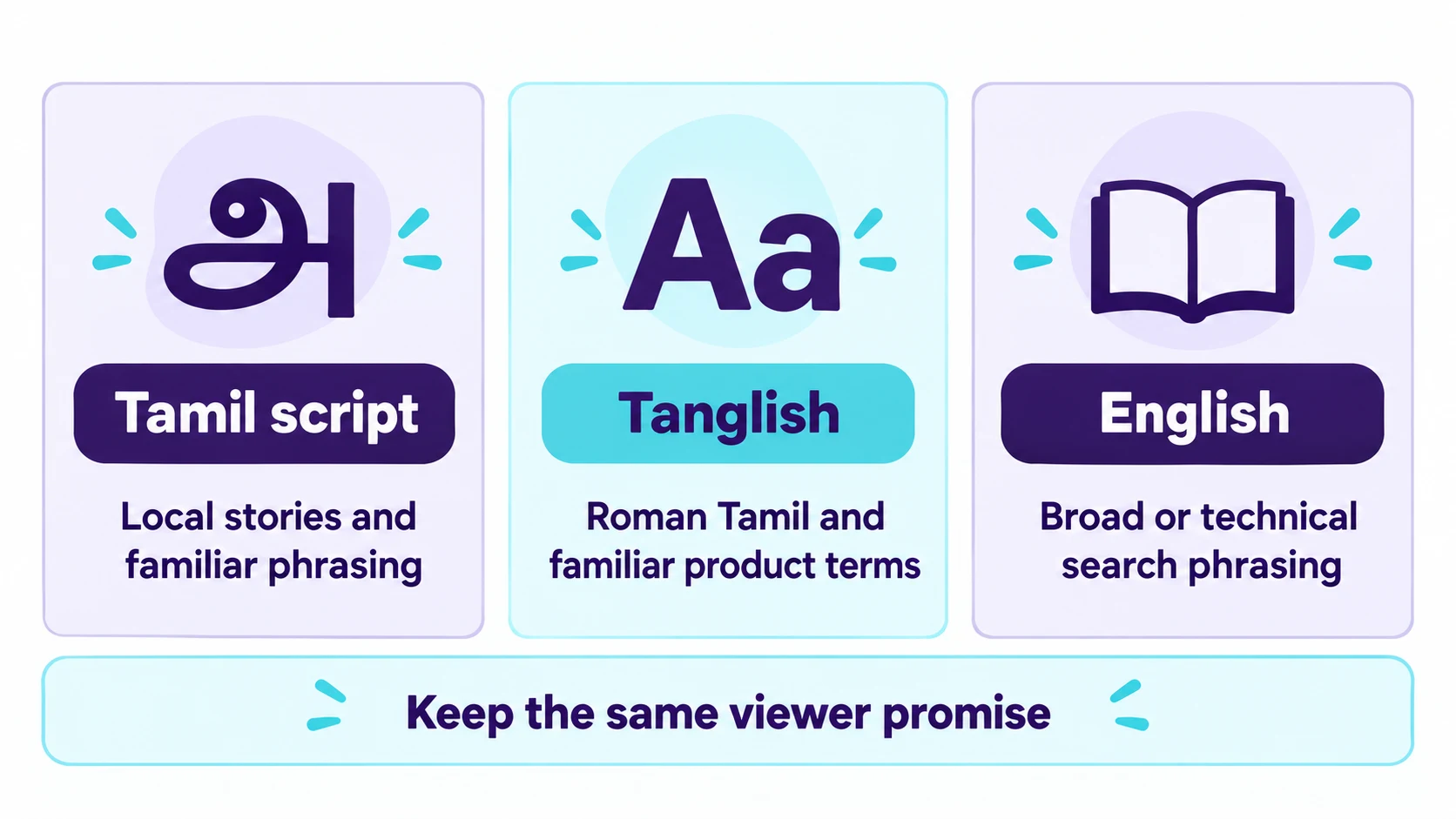
Language choice becomes easier when you start with the task, not the algorithm. A Tamil family-vlog audience may respond quickest to Tamil script. A creator teaching a phone setting may need an English product name because that is how the setting appears on-screen. A gaming or editing audience may already use Tanglish terms in comments. These are audience clues, not rules that apply to every Tamil channel.
Use this decision framework before drafting a title.
| Viewer situation | Strong starting point | What to verify |
|---|---|---|
| Everyday local topic or story | Tamil script or the channel's familiar spoken register | Can the intended viewer read the subject immediately? |
| App, device or software tutorial | Tamil or Tanglish sentence with the recognized English product term | Does the wording match the screen and common search phrasing? |
| Broad Indian or international audience | Clear English or localized metadata alongside the original title | Is English actually useful to the audience you want to reach? |
| Channel community writes in Roman Tamil | Natural Tanglish, reviewed for clarity | Is spelling consistent with how regular viewers write? |
The point is not to make every title look multilingual. It is to remove friction between the viewer's question and the words they see in Search, Home or Suggested.
Worked example: keep the promise identical in three languages
Suppose the video shows how to free phone storage without deleting photos. Start with the neutral promise: "free storage while keeping photos." Then create three natural treatments with a fluent reviewer, not a literal word-for-word translation.
| Treatment | Illustrative title direction | What remains constant |
|---|---|---|
| Tamil script | Tamil wording for freeing phone storage while keeping photos | The device problem, action and limitation |
| Tanglish | "Phone Storage Full Ah? Photos Delete Pannama Clear Pannunga" | The same problem and outcome in familiar Roman Tamil |
| English | "Free Phone Storage Without Deleting Photos" | The same promise for an English-reading viewer |
The precise Tamil-script version should be written or checked by a fluent Tamil editor. The example is not a claim that one treatment will perform best. It shows how to isolate language and script rather than accidentally testing three different ideas.
A simple Tamil vs Tanglish title test
- Write one plain-language promise: who the video helps, what it explains or demonstrates, and what evidence appears in the video.
- Draft that same promise in Tamil script, Tanglish and English. Ask a fluent reviewer to check for natural phrasing if you are not confident in the language.
- Keep the topic, claim and thumbnail concept as close as possible. Do not compare a searchable Tamil tutorial with an English curiosity hook and call the result a language test.
- Check that each version reads clearly when shortened in mobile surfaces. Put the recognizable topic early, then remove filler.
- If native A/B testing is available, compare title-only options and use the watch-time outcome YouTube reports. If testing sequentially, save dates and relevant traffic-source data; viewers and distribution will differ.
- Record the lesson as a hypothesis for similar videos, not a universal rule for the channel.
| Version | Example treatment | Check before publishing |
|---|---|---|
| Tamil script | Natural Tamil phrasing for the device problem and action | Can a Tamil reader understand the subject at a glance? |
| Tanglish | Spoken Tamil written in Latin letters, with familiar product terms | Is spelling consistent and readable for this audience? |
| English | The common English search phrase or product setting | Is it familiar to the intended viewer, not just technically precise? |
For more ways to express one idea without changing what the video promises, see YouTube title formulas by video format. If you compare language variants, the title-testing guide explains the limits of native and sequential tests.
Use translated metadata when one original title is not enough
You do not always need to choose one language forever. YouTube Studio lets creators add translated titles and descriptions, which can help viewers find a video in their language. This is useful when the original video serves a Tamil-speaking core audience but a meaningful secondary audience searches in English, or the other way around.
Treat translation as localization. Preserve the real subject, verify technical terms, and ensure the translated description still matches the video. YouTube uses language-related signals to show translated metadata to suitable viewers, so a translation is a useful accessibility and discovery option, not a guarantee of additional reach. For the current steps, use YouTube's official translated-title workflow.
Common language-choice mistakes
- Translating word for word until the title sounds unnatural to a native viewer.
- Changing both the language and the promise, then calling the result a language test.
- Hiding the important device, game, person or topic behind a vague curiosity phrase.
- Adding English keywords that your target viewers would not use or understand.
- Assuming a title is clear because it sounds natural when spoken, without checking how quickly it reads in a mobile feed.
Choose consistency where it helps your audience, but let the audience's actual words guide the decision. A channel can use Tamil, Tanglish and English across different videos without confusing viewers when every title is clear, accurate and connected to the content.
Should every Tamil YouTube video use Tanglish?
No. A channel can choose language by topic and audience. Review how viewers search and comment, and consider accessibility for people who recognize Tamil speech but are more comfortable reading Roman letters, or vice versa. Keep the language choice consistent enough for the channel to feel coherent, while adapting when audience evidence supports it.
Which is a better YouTube title, Tamil or English?
Neither is automatically better. A clear, accurate title in the audience's preferred reading language is a stronger starting point than an unsupported language rule. Check your own viewers and the actual search phrasing for that topic.
Why are YouTube video titles being translated?
YouTube lets creators add translated titles and descriptions, which may appear in Search for viewers who speak those languages. Translated metadata is a separate choice from the original title language, so check YouTube Studio's [translation workflow](https://support.google.com/youtube/answer/6289575?hl=en) when you want to localize a video.
Can I use Tamil and English in the same YouTube title?
Yes, when the mixed wording is natural for the intended audience and clarifies the topic. Keep product names, settings and technical terms in the form viewers recognize, but do not mix scripts merely to make the title look more searchable.
Is Tanglish easier to rank on YouTube than Tamil?
There is no reliable universal rule. Ranking and recommendation depend on viewer response, relevance and many other signals. Choose the wording your target viewer is most likely to recognize, then use your own search terms, comments and test results as evidence.
Should I add translated titles instead of changing my original title?
Often, yes. A translated title and description can help YouTube display metadata in another language while preserving the original title for its core audience. Use the Studio translation workflow when the extra language serves a real viewer group.
How do I write Tamil script correctly for a title?
Start with the phrase your intended viewer would naturally use, then ask a fluent Tamil reader to review spelling, tone and clarity. Do not rely on a literal machine translation for a public title without human review.
Your next step
Choose one upcoming video and draft equivalent Tamil, Tanglish and English versions. Use the Scriptio is on a break until April 1, 2027 to explore wording options, then have a fluent reviewer confirm that each version sounds natural and keeps the same promise.
Sources: YouTube thumbnail and title tips, YouTube A/B testing titles and thumbnails, YouTube translated title and description workflow